Skip to Main Content (Press Enter)
I want to...
loading content

Read timed out

POST https://dxp-webcarconfig.toyota-europe.com/v1/grade-selector/cy/en?modelId=ea59a13e-d471-4e34-9068-c149abd01723

Toyota Relax

Every new Toyota commercial vehicle comes with a 3 year/100.000km manufacturer warranty. Once your service is due, all you need to do is bring your Toyota commercial in for a service and your Toyota Relax warranty will be renewed free of charge until your next service is due—up to 10 years vehicle age or 185,000km (whichever comes first). Terms and conditions apply.

Express service

We guarantee to complete scheduled maintenance services in 60 minutes or less through our Express Service lane at no extra cost. (Toyota Hilux excluded)*

Roadside Assistance (free with Toyota Insurance)

We will get you up and running again as quickly as possible. With Toyota Insurance you can be sure that you will receive immediate attention, wherever you are. Secure free 24hr assistance in case of an emergency, a road accident, mechanical trouble, or any other breakdown.

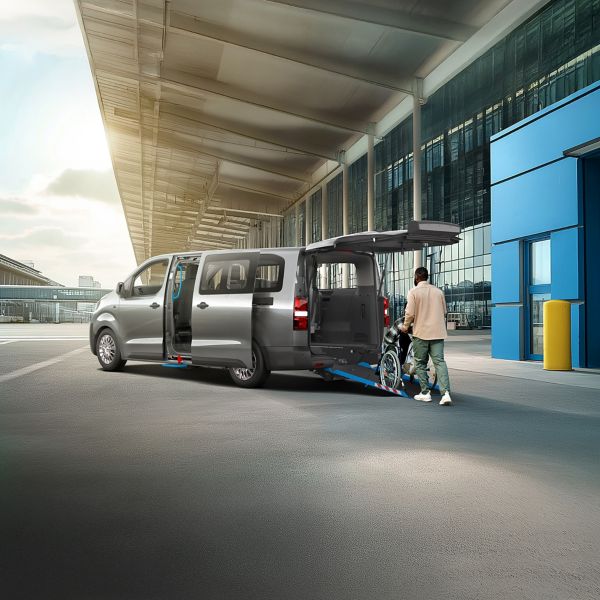
Courtesy & Mobility Vans

Need a van when yours is being serviced with us? Our range of mobility vans are here to keep you moving for your business.

Finance and insurance

We offer affordable and flexible business and fleet financing options available from local financial institutions to suit your business. In collaboration with Genikes Insurance, Toyota Insurance lets you enjoy tailor-made products for your Toyota and one of the most comprehensive levels of cover available.

Toyota Care

Enjoy complete peace of mind and by keeping your Toyota Commercial vehicle in top condition and for less than you think. Toyota Care is a prepaid service plan for 3 years/60.000km available for your business which maintains the reliability and safety of your Toyota Commercial vehicle and protects you from rising maintenance costs. *Only service maintenance up to 60.000km
  • Electric

    Battery size
    110 kWh
    Power
    270 hp*
    Range
    up to 420km*
    10-80% Charging time DC
    55 minutes
    Load volume
    up to 17m³
    Towing Capacity
    2400 kg
    * Combined
  • Diesel

    Powertrain
    2.2 l diesel
    Power
    120 hp to 180 hp
    Fuel consumption
    from 7.5 l/100km
    CO₂ emissions
    from 198 g/km
    Load volume
    up to 17m3
    Towing Capacity
    up to 3000 kg

Conversions

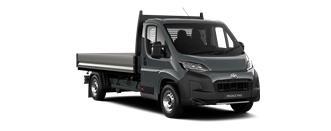
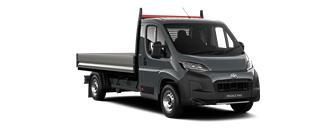
Toyota offers a range of conversions, from Tippers to wheelchair accessible vehicles.
Learn more about Toyota conversions

FAQs

  1. All

A Battery Electric vehicle has no engine and runs on electricity alone, with the battery powering one or more electric motors. Hybrids combine a traditional engine and an electric powertrain – usually a self-charging battery and an electric motor. In a Hybrid vehicle the combustion engine, electric motor and battery work together. The electric motor boosts performance while also working as a generator to turn surplus energy into electrical charge, reducing fuel consumption.

Charging your electric vehicle is simple and convenient. Charge whenever it suits you using the supplied cable and a domestic power socket or via a dedicated Toyota HomeCharge. For quick charging on the go, the expanding network of rapid chargers in locations like motorway service stations and supermarket car parks could have you topped up and on the road in as little as 30 minutes.* 


*A charge from a 10% state of charge to 80% can be achieved in around 55 minutes with 150kW DC charging in optimal conditions, such as a temperature of around 25°C. In order to ensure effective charging and preserve battery health over the life of the vehicle, DC Fast Charging power of the Toyota Proace Max may be reduced temporarily (for roughly 24 hours) after 3.8 sessions per day (equivalent of 3.8 times 10% to 80% state of charge).

Tax relief incentives in many countries make it more rewarding to switch to a Battery Electric car. Battery Electric vehicles are often also exempt from road tax and charges for entering congestion zones and low-emission zones, saving you money. Charging an electrified vehicle can be more cost-effective than refuelling a petrol or diesel vehicle*. Charge at home overnight and it can also be more convenient than detouring to a fuel station.


*When you charge at home on an off-peak energy tariff

A charge from a 10% state of charge to 80% can be achieved in 55 minutes* with 150kW DC charging in optimal conditions, such as a temperature of around 25°C. To protect battery health and longevity, DC fast charging performance is reduced once the state of charge reaches 80%**. Please consult our charging time calculator to estimate your charging time. Simply input your specific conditions, such as the type of charger you’re using and the ambient temperature.


*A charge from a 10% state of charge to 80% can be achieved in around 55 minutes with 150kW DC charging in optimal conditions, such as a temperature of around 25°.


**In order to preserve battery health over the life of the vehicle, DC Fast Charging power of the Toyota Proace Max may be reduced temporarily (for roughly 24 hours) after 3.8 sessions per day (equivalent of 3.8 times 10% to 80% state of charge).

With  a current of 32 amps, the minimum time to fully charge is 11.6 hours*. Please consult our charging time calculator to estimate how long charging will take in specific conditions, such as the type of charger and ambient temperature.


*In optimal conditions, such as a temperature of around 25°C.

Selecting the Eco Driving Mode will increase efficiency and maximise use range, as will activating the Auto Eco Mode for the heater. Consider turning off the air-conditioning when not required and remember the heated seats and steering wheel are a more efficient way of staying warm than turning up the heater. It’s also a good idea to pre-condition the cabin while the car is still on charge – you can do this via the MyToyota app or vehicle's car’s multimedia display. Ensure your tyre pressures are correctly adjusted. Low pressures will reduce use range. Winter tyres also consume more electricity on dry roads than summer tyres. Carrying unnecessary weight will increase energy usage, so be sure to remove surplus items from the vehicle. Finally, consider modifying your driving behaviour. Driving at a constant, moderate speed and avoiding unnecessary acceleration and braking will help you go further on a charge. When you do need to alter your speed, do so smoothly to decrease your energy usage.