Skip to Main Content (Press Enter)
I want to...

How Toyota is advancing safety through precision drifting with two Supras!

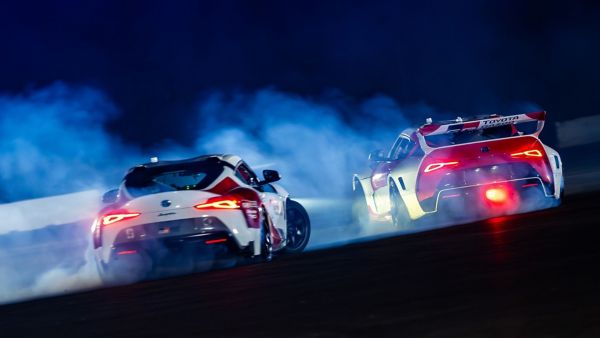
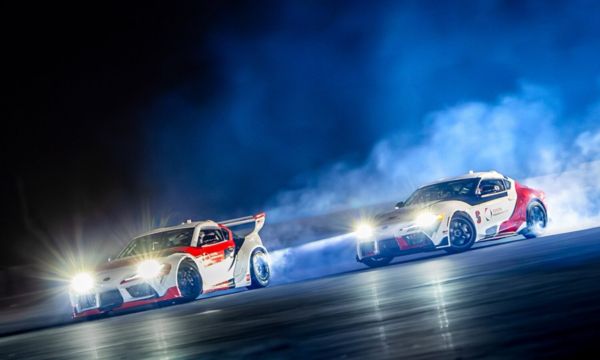
The Toyota Research Institute and Stanford Engineering have achieved the world’s first fully autonomous drifting drive. This artificial intelligence research project aims to improve driving safety. In a groundbreaking world first, Toyota successfully demonstrated two cars drifting side by side with no drivers behind the wheel.

For nearly seven years, the two organizations have been collaborating on research focused on making driving safer. The experiments automate a motorsport maneuver known as drifting, where the driver precisely controls the direction of the vehicle after losing traction. By introducing a second car moving in parallel, the research teams can better simulate the conditions that occur during dangerous accident scenarios involving other vehicles, pedestrians, or cyclists.

“Our researchers came together with one goal in mind – to make driving safer,” said Avinash Balachandran, Vice President of Human Interactive Driving at the Toyota Research Institute. “Now, by leveraging the latest tools in artificial intelligence, we are able to dynamically control vehicles at their limits. This has significant implications for the development of advanced safety systems in future vehicles.”

“When your car begins to slip or skid, you rely entirely on your driving skills to avoid colliding with another vehicle, a tree, or an obstacle,” added Balachandran. “The average driver struggles to handle these extreme conditions, and a fraction of a second can mean the difference between life and death. This new technology can activate in time to protect a driver and manage a loss of control, just as a skilled driver would.”

“The physics of drifting are actually quite similar to what a car may experience on snow or ice,” explained Chris Gerdes, Professor of Mechanical Engineering and Director of the Center for Automotive Research at Stanford (CARS).

Road accidents result in more than 40,000 deaths each year in the United States and around 1.35 million worldwide. Many of these incidents are caused by a loss of control in sudden, dynamic situations. Autonomous technologies hold great promise in helping drivers respond more effectively in such moments.

Watch the video here:

https://www.youtube.com/watch?v=8J_WiT-RD74