* Combined 75 kWh battery
loading content
Forced client side injection based on cached strategy
POST https://dxp-webcarconfig.toyota-europe.com/v1/grade-selector/cy/en?modelId=b0fec657-68ed-4858-b470-ee998aa53d8a&filterIndex=0
-
Electric
Battery sizes75 kWhPower100 kWRangeup to 350km*10-80% Charging time DC32 minutes**Towing Capacity1000 kg -
Diesel
Powertrain2.0 l dieselPowerup to 177 DIN hp*Fuel consumption7.2-7.9 l/100 km*CO₂ emissions189-208 g/km*Towing Capacity1800-1900 kg* 2.0 l D-4D 180 8 A/T
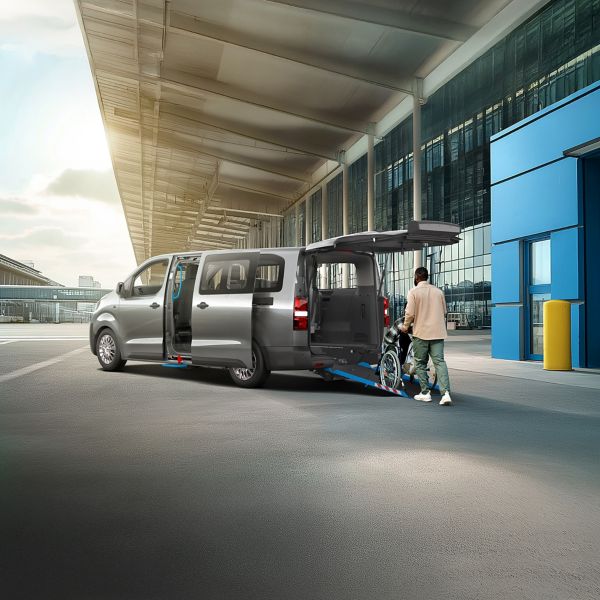
Conversions
Toyota offers a range of conversions, from Tippers to wheelchair accessible vehicles.
Learn more about Toyota conversions
FAQs
- All
- Electric car performance
- Battery Electric
- Charging
Frequently asked questions
The WLTP range figure is an estimate based on the WLTP (Worldwide harmonised Light vehicle Test Procedure) regulations. These are a global standard Toyota follows rigorously. Use range will deviate from the WLTP value when key factors, including speed, road surface, driving behaviour and ambient temperature, differ from those specified in the WLTP test cycle. Toyota’s Proace Verso website and brochure show a WLTP range of up to 350km but variables may cause the use range to be lower. Please consult our range calculator to anticipate your real-world range in specific conditions, such as temperature, wheel size, driving mode and air-conditioning setting.
Selecting the Eco Driving Mode will increase efficiency and maximise use range, as will activating the Auto Eco Mode for the heater. Consider turning off the air-conditioning when not required and remember the heated seats and steering wheel are a more efficient way of staying warm than turning up the heater. It’s also a good idea to pre-condition the cabin while the car is still on charge – you can do this via the MyToyota app or vehicle's car’s multimedia display. Ensure your tyre pressures are correctly adjusted. Low pressures will reduce use range. Winter tyres also consume more electricity on dry roads than summer tyres. Carrying unnecessary weight will increase energy usage, so be sure to remove surplus items from the vehicle. Finally, consider modifying your driving behaviour. Driving at a constant, moderate speed and avoiding unnecessary acceleration and braking will help you go further on a charge. When you do need to alter your speed, do so smoothly to decrease your energy usage.
A Battery Electric vehicle has no engine and runs on electricity alone, with the battery powering one or more electric motors. Hybrids combine a traditional engine and an electric powertrain – usually a self-charging battery and an electric motor. In a Hybrid vehicle the combustion engine, electric motor and battery work together. The electric motor boosts performance while also working as a generator to turn surplus energy into electrical charge, reducing fuel consumption.
Modern Battery Electric vehicles can travel further than you might think. The Toyota Proace Verso can travel up to 350km* on a single full charge.
*These range figures are estimates based on official homologation figures in a controlled environment (WLTP). These figures are provided solely for comparison purposes: only compare them with other vehicles tested to the same technical procedures. Estimated range assumes that the battery is fully charged (100%) and fully depleted (0%).
The actual electric range value of your vehicle will vary from these calculated values, since many factors have an influence on a vehicle's electric range. Such factors include: selected grade, optional equipment and accessories fitted, driving style, speed, road conditions, traffic, vehicle condition, tyre type (summer/winter) and pressure, vehicle load, number of passengers, external temperature, battery temperature, etc.
The tool provides an indicative impact for variations in some of these factors but this will not reflect your actual use. For more info about WLTP contact your local Toyota Centre.
Charging your electric vehicle is simple and convenient. Charge whenever it suits you using the supplied cable and a domestic power socket or via a dedicated Toyota HomeCharge. For quick charging on the go, the expanding network of rapid chargers in locations like motorway service stations and supermarket car parks could have you topped up and on the road in as little as 30 minutes.*
*A charge from a 10% state of charge to 80% can be achieved in around 32-45 minutes with 150kW DC charging in optimal conditions, such as a temperature of around 25°C. In order to ensure effective charging and preserve battery health over the life of the vehicle, DC Fast Charging power of the Toyota Proace may be reduced temporarily (for roughly 24 hours) after 3.8 sessions per day (equivalent of 3.8 times 10% to 80% state of charge).
Tax relief incentives in many countries make it more rewarding to switch to a Battery Electric car. Battery Electric vehicles are often also exempt from road tax and charges for entering congestion zones and low-emission zones, saving you money. Charging an electrified vehicle can be more cost-effective than refuelling a petrol or diesel vehicle*. Charge at home overnight and it can also be more convenient than detouring to a fuel station.
*When you charge at home on an off-peak energy tariff
A charge from a 10% state of charge to 80% can be achieved in 32-45 minutes* with 150kW DC charging in optimal conditions, such as a temperature of around 25°C. To protect battery health and longevity, DC fast charging performance is reduced once the state of charge reaches 80%**. Please consult our charging time calculator to estimate your charging time. Simply input your specific conditions, such as the type of charger you’re using and the ambient temperature.
*A charge from a 10% state of charge to 80% can be achieved in around 32-45 minutes with 150kW DC charging in optimal conditions, such as a temperature of around 25°.
**In order to preserve battery health over the life of the vehicle, DC Fast Charging power of the Toyota Proace Verso may be reduced temporarily (for roughly 24 hours) after 3.8 sessions per day (equivalent of 3.8 times 10% to 80% state of charge).
For vehicles with a 50kW battery, with a current of 32 amps, the minimum time to fully charge is 4.8 hours*. Vehicles with a 75kW battery can be fully charged in 7.5 hours* with an 11kW charge point. Please consult our charging time calculator to estimate how long charging will take in specific conditions, such as the type of charger and ambient temperature.
*In optimal conditions, such as a temperature of around 25°C.